How to Choose Cosmetic Packaging for Serums, Creams and Lotions
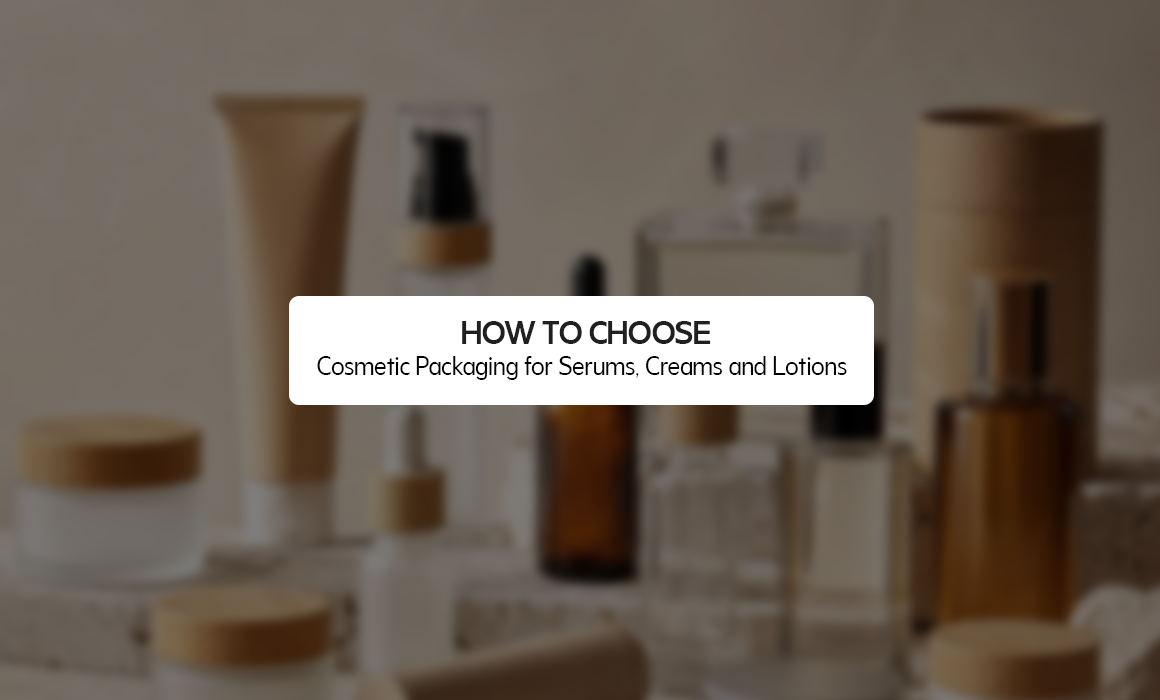
Choosing the right cosmetic packaging is an important step in developing a successful skincare product. Packaging does more than make a product look attractive. It protects the formula, supports convenient application, communicates brand quality, and helps customers understand how to use the product correctly.
Serums, creams, and lotions have different textures, ingredients, and application needs. A lightweight facial serum may require a dropper or pump, while a rich face cream may work better in a jar or airless container. Body lotion often needs a bottle that allows customers to dispense the product quickly and easily.
The best cosmetic packaging depends on the product formula, its sensitivity to air and light, the intended customer, manufacturing requirements, and the brand's long-term goals.
This guide explains how to select suitable cosmetic packaging for different skincare products, compare available materials, avoid common mistakes, and create packaging that balances protection, usability, appearance, and environmental considerations.
Understand the Purpose of Cosmetic Packaging
Before selecting a bottle, jar, or dispenser, identify what the packaging must do for your product. Good packaging should protect the formula while making storage, transportation, and daily use convenient.
Protect the Formula From External Factors
Some skincare ingredients can lose stability when exposed to oxygen, light, heat, or moisture. Packaging helps limit these exposures, although the level of protection depends on the container design and material.
For example, a product containing light-sensitive ingredients may benefit from an opaque or UV-protective container. A formula that oxidizes easily may require a well-sealed closure or an airless dispensing system.
Improve the Customer Experience
Customers should be able to dispense the right amount without unnecessary mess or product waste. The container should also feel comfortable to hold, open, close, and store.
Consider these practical questions:
- Can customers use the product with clean hands?
- Is the dispenser suitable for the formula's thickness?
- Can customers control how much product comes out?
- Does the closure prevent leakage during travel?
- Can the container stand securely on a shelf?
Communicate Brand Quality
Packaging creates an immediate impression of the product. A simple bottle can suit a practical everyday skincare range, while a weighted glass container may support a more premium presentation.
However, expensive-looking packaging does not automatically mean better product protection. Formula compatibility and reliable performance should always come first.
Choose the Right Packaging for Serums, Creams and Lotions
Each skincare category has different dispensing requirements. Start with the product's texture, then consider the ingredients and how customers will apply it.
Best Packaging for Facial Serums
Serums are often lightweight formulas designed for targeted skincare routines. Their packaging should support controlled application and help protect sensitive ingredients when necessary.
Common options include:
- Dropper bottles for liquid serums and facial oils.
- Airless pump bottles for compatible treatment formulas.
- Small dispensing bottles for lightweight, water-based products.
- Opaque containers for formulas that need protection from light.
For example, a lightweight hydrating serum may work well in a dropper bottle. A serum containing oxidation-sensitive ingredients may be better suited to a compatible airless system or another container that provides an appropriate barrier.
Best Packaging for Face Creams
Face creams range from lightweight moisturizers to thick night creams. Their packaging must accommodate the product's consistency without making application difficult.
A jar offers a wide opening, which helps customers access thick creams. An airless dispenser can reduce direct contact with the formula during normal use. A tube can work well for eye creams, travel products, and targeted treatments.
Best Packaging for Body Lotions
Body lotions usually require packaging that makes repeated application easy. Customers may use these products over large areas, so comfortable dispensing and a suitable container size matter.
Pump bottles are useful for everyday body lotions because they allow convenient, repeatable dispensing. Squeeze bottles work well for products with a suitable consistency, particularly when portability is important.
| Product type | Suitable packaging options | Main consideration |
|---|---|---|
| Lightweight serum | Dropper or compatible pump | Controlled dispensing |
| Sensitive treatment serum | Suitable airless or protective bottle | Formula stability |
| Rich face cream | Jar, tube, or suitable airless dispenser | Texture and access |
| Eye cream | Small tube or precision dispenser | Controlled application |
| Body lotion | Lotion pump or squeeze bottle | Ease of repeated use |
| Body butter | Wide-mouth jar or suitable high-viscosity dispenser | Thick consistency |
These are starting points rather than universal rules. Always test the exact formula in the proposed container before approving production.
Compare Cosmetic Packaging Materials
The material affects durability, product protection, appearance, shipping weight, and disposal options. Selecting the right material requires more than comparing how the containers look.
Glass Packaging
Glass is popular for premium skincare products because it offers a substantial feel and can provide good chemical resistance with an appropriate formulation and closure.
Advantages include:
- A premium appearance.
- Good resistance to many cosmetic ingredients.
- Availability in clear, amber, and colored finishes.
- Suitability for many serum and facial oil formulas.
However, glass can break during transportation, adds weight, and may increase shipping requirements. Clear glass also allows light to reach the formula unless another protective feature is used.
Plastic Packaging
Plastic is widely used for skincare because manufacturers can produce it in many shapes, sizes, and dispensing formats.
Common options include PET, HDPE, and PP. Each has different properties, so the specific grade and complete packaging assembly must be checked against the formula.
Advantages include low weight, design flexibility, and resistance to breakage compared with glass.
The main consideration is chemical compatibility. Certain ingredients can affect specific plastics, seals, or dispensing components. A plastic that works for a water-based lotion may not be appropriate for another formula containing different solvents, oils, or fragrance materials.
Tubes and Flexible Materials
Tubes are useful when customers need to squeeze out a controlled amount of cream or lotion. Some designs include barrier layers that help reduce the movement of oxygen, moisture, or other substances through the package.
Their performance depends on the tube construction, internal layers, closure, and formula.
Material Comparison
| Material or format | Advantages | Limitations |
|---|---|---|
| Glass | Premium appearance and good chemical resistance for many formulas | Heavy and breakable |
| PET plastic | Lightweight, clear, and versatile | Compatibility must be verified |
| HDPE plastic | Lightweight and useful for many everyday products | Often less transparent |
| PP plastic | Used in many caps, jars, and dispensing systems | Performance depends on grade and design |
| Flexible laminate tube | Convenient dispensing and potential barrier protection | Multiple layers may complicate recycling |
| Recycled-content plastic | Can support responsible material sourcing | Color, supply, and quality may vary |
Choose the material based on verified performance rather than appearance alone. A suitable package should maintain its integrity throughout storage, transport, and normal use.
Understand Packaging Closures and Dispensing Systems
The closure is an essential part of cosmetic packaging. Even a high-quality bottle can cause problems if its pump, cap, or dropper does not suit the formula.
Dropper Closures
Dropper systems allow users to draw up and release small amounts of liquid. They are commonly associated with facial serums and oils.
Before selecting one, check whether the liquid can be drawn into the pipette consistently. Test the bulb, pipette, closure, and seal for compatibility with the formula.
A dropper is not automatically the best option for every serum. Thick formulas may be difficult to draw, while very thin liquids can release too quickly.
Pump Dispensers
Pump systems are suitable for many serums, creams, and lotions. They can provide a convenient way to dispense a repeatable amount without placing fingers inside the container.
Important factors include pump output, the force required to press it, the size of the dispensing opening, and whether the product can flow through the mechanism.
Airless Packaging
An airless system typically uses a piston or flexible internal structure to move the formula toward the dispenser while limiting air from returning to the product chamber.
It can be useful for formulas that benefit from reduced exposure during use. However, airless packaging does not eliminate every cause of product degradation or replace appropriate preservation and stability testing.
Jars, Caps and Squeeze Closures
Jars work well for products that need a wide opening, while flip-top caps and squeeze closures can suit creams and lotions designed for direct dispensing.
Consider how the closure will behave when the package is carried in a bag, stored upside down, or used with wet hands.
Expert tip: Test the entire assembly, not just the container. The cap, liner, pump, seals, and product-contact components all contribute to packaging performance.
Match Packaging With Ingredients and Formula Stability
A skincare formula and its packaging should be evaluated as one system. Ingredients can interact with packaging materials, and the container can influence the formula's exposure to external conditions.
Consider Light and Oxygen Sensitivity
Some ingredients are sensitive to light or oxygen. Depending on the formula, exposure may cause changes in color, odor, or performance.
A brand developing a serum with sensitive active ingredients should consider whether opaque packaging, colored glass, a suitable barrier, or an airless dispensing system would provide appropriate protection.
The best solution depends on the complete formulation rather than the presence of a single ingredient.
Check Compatibility With Oils, Fragrances and Acids
Oils, fragrance components, solvents, and acidic ingredients can behave differently when they contact various packaging materials.
Ask the packaging supplier for material specifications and confirm that the proposed components are suitable for the intended product.
Do not assume that all bottles made from the same broad material category will perform identically.
Test Stability and Packaging Performance
Before full-scale manufacturing, assess the product in its final packaging.
Useful checks include:
- Changes in color, odor, texture, and appearance.
- Leakage around caps, pumps, and closures.
- Cracking, swelling, deformation, or other material changes.
- Pump operation and consistency of dispensing.
- Label adhesion and print durability.
- Performance under appropriate temperature and storage conditions.
- Microbiological quality and preservation effectiveness where applicable.
For water-containing products, suitable preservation and microbiological testing remain important even when the package limits direct contact with the formula.
Design Packaging for Branding and Customer Usability
Packaging should communicate the brand's identity without making the product difficult to use. Strong design balances appearance, readability, function, and production practicality.
Select a Consistent Visual Style
Choose a design direction that fits the intended customer and product category.
For example, a minimalist skincare brand may use restrained colors, clean typography, and simple container shapes. A botanical skincare range may prefer earthy colors and a more natural visual style.
These choices should remain consistent across serums, creams, and lotions so that customers can recognize the product family.
Make Labels Easy to Read
The label should help customers identify the product and understand its intended use.
Prioritize:
- Product name and type.
- Net quantity.
- Ingredient information where required.
- Directions for use.
- Relevant warnings and precautions.
- Manufacturer, responsible-person, or business details as required in the target market.
- Batch identification and other required information.
Check that the chosen container provides enough space for required text. A beautiful design is not useful if the instructions become unreadable.
Consider Everyday Handling
The package should be comfortable to hold and operate. A heavy glass jar may look attractive but can be less convenient for travel. A large pump bottle may work well at home but take up too much space in a small bathroom.
Consider grip, opening force, dispensing control, storage, and the amount of product customers can reasonably use before the container becomes difficult to handle.
Best practice: Ask people who represent your intended customers to try the packaging before finalizing the design. Their feedback can reveal usability problems that are easy to miss during design development.
Evaluate Sustainability, Manufacturing and Shipping
Packaging decisions affect material use, transportation, production efficiency, and end-of-life disposal. A responsible choice considers the complete packaging system rather than relying on a single environmental claim.
Reduce Unnecessary Packaging
Use a container size that matches the product volume and purpose. Avoid excessive outer boxes, decorative inserts, or oversized containers that add material without providing meaningful protection.
However, removing packaging should not compromise hygiene, product integrity, transport safety, or legally required information.
Consider Recycled and Refillable Options
Recycled-content materials can help reduce demand for newly produced material. Refillable systems may also reduce packaging waste when customers can use them safely and conveniently.
Before adopting either approach, check material quality, availability, cleaning requirements, and compatibility with the formula.
A refill system should be designed so that the main container can be reused as intended without creating unnecessary contamination risks.
Review Shipping and Storage Requirements
Packaging must withstand the conditions it will encounter between manufacturing and customer delivery.
Check whether containers can tolerate stacking, vibration, handling, and expected temperature changes. Secure closures and suitable protective shipping materials can reduce leakage and breakage.
| Decision factor | Questions to ask |
|---|---|
| Material use | Can the package use less material without losing protection? |
| Recycled content | Is the material suitable and consistently available? |
| Refill options | Can customers refill it safely and conveniently? |
| Recycling | Can local facilities process the actual packaging components? |
| Transportation | Is the package resistant to leakage, breakage, and deformation? |
| Manufacturing | Can the supplier fill, seal, and label it consistently? |
Avoid broad claims such as completely sustainable or fully recyclable unless the claim can be supported for the complete package and the relevant market.
Plan Costs, Supplier Selection and Quality Control
The lowest unit cost does not always produce the best overall result. Packaging selection should consider the full cost of getting a reliable, finished product to the customer.
Compare the Total Packaging Cost
The overall cost can include the container, closure, label, decoration, assembly, filling, quality checks, protective shipping materials, and transportation.
Custom molds and specialized dispensing systems can add development time and manufacturing complexity. Standard packaging may be more practical for a new brand that needs to test customer demand before expanding.
Request quotations based on the complete specification rather than comparing bottles alone.
Assess Packaging Suppliers
Ask potential suppliers about material specifications, production consistency, sample availability, minimum order quantities, lead times, and quality-control procedures.
Request documentation relevant to the proposed material and intended use. Confirm that production samples match the components that will be supplied in the commercial order.
Create a Quality-Control Checklist
Before approving a packaging order, confirm the following:
- The container holds the intended fill volume.
- The closure fits securely.
- The dispensing system works with the actual formula.
- The package does not leak under expected handling conditions.
- Labels remain attached and readable.
- The material is compatible with the product.
- Required markings and label information are correct.
- Production samples meet the agreed specifications.
Keep approved samples and written specifications for future comparisons. This can help identify differences between production batches and reduce avoidable packaging problems.
Avoid Common Cosmetic Packaging Mistakes
Many packaging problems can be prevented by testing early and involving both formulation and packaging specialists.
Choosing by Appearance Alone
A container may look attractive but fail to dispense the product properly or protect it adequately.
Better approach: Confirm compatibility, dispensing performance, and durability before approving the visual design.
Using the Same Container for Every Product
A serum, rich cream, and body lotion do not necessarily share the same packaging needs.
Better approach: Evaluate each formula separately, even when the products belong to one collection.
Ignoring the Dispensing Mechanism
A pump may clog, struggle with a thick formula, or dispense too much product per press.
Better approach: Test repeated dispensing with the actual formula, including when the container is nearly empty.
Overlooking Transportation Risks
A closure that performs well on a shelf may loosen or leak during shipping.
Better approach: Conduct suitable leakage, handling, and transport tests before releasing the product.
Making Unsupported Environmental Claims
A package may contain recycled material but still combine components that are difficult to separate or recycle locally.
Better approach: Review the complete package and make only claims that can be substantiated.
Finalizing Packaging Too Early
Changing the formula after packaging approval can create new compatibility or dispensing issues.
Better approach: Coordinate formulation development, packaging selection, stability assessment, and production planning from the beginning.
Conclusion
Choosing cosmetic packaging for serums, creams, and lotions requires a balance of product protection, material compatibility, dispensing performance, brand presentation, and practical manufacturing needs.
Dropper bottles may suit some liquid serums, jars can accommodate rich creams, and pump bottles can make everyday lotion application easier. Airless systems and protective materials may offer advantages for selected formulas, but their suitability must be confirmed through testing.
The most reliable approach is to understand the formula first, shortlist appropriate packaging formats, assess suppliers, and test the complete package before committing to large-scale production.
When packaging supports both the formula and the customer, it becomes a valuable part of the product experience rather than just an outer container.
Frequently Asked Questions
1. What is the best packaging for facial serums?
The best option depends on the serum's viscosity, ingredients, and application method. Dropper bottles can work well for certain liquid serums, while compatible pumps or airless containers may suit other formulas. Test the complete packaging system before making a final decision.
2. Are glass or plastic bottles better for skincare products?
Neither material is universally better. Glass offers a premium appearance and good chemical resistance for many formulas, while plastic is lightweight and less prone to breakage. The right choice depends on formula compatibility, protection needs, shipping conditions, and disposal options.
3. Is airless packaging suitable for creams and lotions?
Yes, airless packaging can work for many creams, lotions, and serums when the dispensing system matches the product's texture. It can limit air entering the product chamber during use, but it does not replace proper formulation, preservation, or stability testing.
4. How can I make cosmetic packaging more environmentally responsible?
Consider reducing unnecessary material, selecting suitable recycled-content materials, evaluating refill systems, and checking whether local recycling facilities accept the actual components. Balance these decisions with product protection, hygiene, durability, and accurate environmental claims.
5. What should I test before choosing a cosmetic packaging supplier?
Evaluate material compatibility, closure security, leakage resistance, dispensing consistency, label durability, production quality, lead times, and supplier documentation. Test samples with the final formula and confirm that commercial production will match the approved specifications.